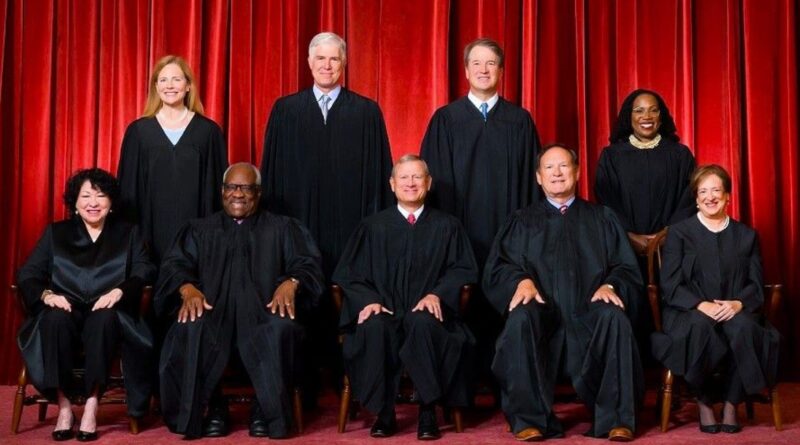
BREAKING: Supreme Court Hands President Trump UNANIMOUS Win!
9-0.
Even Ketanji Jackson just voted to give President Trump a win!
The U.S. Supreme Court delivered a unanimous ruling on Wednesday that favored the Trump administration in an important immigration dispute. In a 9–0 decision, the justices concluded that federal appellate courts must give deference to immigration judges and the Board of Immigration Appeals when determining whether the harm described by an asylum applicant legally qualifies as persecution.
Justice Ketanji Brown Jackson authored the opinion for the Court. The case centered on how courts should evaluate asylum claims under the Immigration and Nationality Act, which provides protection to individuals who demonstrate a well-founded fear of persecution if they return to their country of origin.
While asylum seekers can challenge negative rulings from immigration judges, the dispute before the Court focused on the nature of those rulings. Specifically, the justices considered whether such determinations should be treated as factual findings—meaning federal courts must largely defer to the agency’s judgment when reviewing them.
In the Court’s written opinion, Jackson explained the standard that must apply when reviewing those decisions.
“We conclude that the statute requires application of the substantial-evidence standard to the agency’s conclusion that a given set of undisputed facts does not constitute persecution,” Jackson wrote. “Accordingly, we affirm.”
As a result of the ruling, immigration authorities gain a stronger position in asylum litigation. Federal judges will now have less room to revisit or reinterpret the factual record in these cases, provided the agency’s decision rests on “reasonable, substantial, and probative evidence.”
The dispute itself involved Douglas Humberto Urias-Orellana, his wife, Sayra Iliana Gamez-Mejia, and their child. The family left El Salvador in 2021, claiming they were fleeing what they described as a “years-long, violent vendetta against their extended family” carried out by a cartel hitman.
https://twitter.com/EricLDaugh/status/2029219207221547308?ref_src=twsrc%5Etfw%7Ctwcamp%5Etweetembed%7Ctwterm%5E2029219207221547308%7Ctwgr%5E5c2955a4e85a98139a35d280c403c3e5586a2723%7Ctwcon%5Es1_&ref_url=https%3A%2F%2Fwltreport.com%2F2026%2F03%2F04%2Fbreaking-supreme-court-hands-president-trump-unanimous-win%2F
You can read the complete opinion here:
https://www.supremecourt.gov/opinions/25pdf/24-777_9ol1.pdf
FULL TEXT OPINION:
(Slip Opinion) OCTOBER TERM, 2025
Syllabus
NOTE: Where it is feasible, a syllabus (headnote) will be released, as is being done in connection with this case, at the time the opinion is issued. The syllabus constitutes no part of the opinion of the Court but has been prepared by the Reporter of Decisions for the convenience of the reader. See United States v. Detroit Timber & Lumber Co., 200 U. S. 321, 337.
SUPREME COURT OF THE UNITED STATES
Syllabus
URIAS-ORELLANA ET AL. v. BONDI, ATTORNEY GENERAL
CERTIORARI TO THE UNITED STATES COURT OF APPEALS FOR THE FIRST CIRCUIT
No. 24–777. Argued December 1, 2025—Decided March 4, 2026
This case presents the question whether the courts of appeals must apply substantial-evidence review to the Board of Immigration Appeals’ determination whether a given set of undisputed facts constitutes “persecution” under 8 U. S. C §1101(a)(42).
Petitioners Douglas Humberto Urias-Orellana, his wife Sayra Iliana Gamez-Mejia, and their minor child G. E. U. G., are natives of El Salvador who entered the United States without authorization in 2021. After being placed in removal proceedings, petitioners applied for asylum. Under the Immigration and Nationality Act (INA), the U. S. Government “may grant asylum” to a noncitizen if it “determines” that he “is a refugee.” §1158(b)(1)(A). An asylum seeker qualifies as a “refugee” if he “is unable or unwilling to return” to his country of nationality “because of persecution or a well-founded fear of persecution on account of race, religion, nationality, membership in a particular social group, or political opinion.” §1101(a)(42)(A).
In support of petitioners’ applications for asylum, Urias-Orellana testified that he was being targeted by a hitman in El Salvador. The Immigration Judge (IJ) found Urias-Orellana’s testimony credible but concluded that it did not establish past persecution or a well-founded fear of future persecution under the INA. The IJ accordingly denied the petitioners’ asylum applications and ordered their removal. The Board of Immigration Appeals (BIA) affirmed. On petition for review, the U. S. Court of Appeals for the First Circuit also affirmed, holding that, under the substantial-evidence standard of review, the record did not compel a contrary finding.
Held: The INA requires application of the substantial-evidence standard to the agency’s determination whether a given set of undisputed facts rises to the level of persecution under §1101(a)(42)(A). Pp. 5–13.
(a) Section 1252(b)(4) sets forth the scope and standard of review for courts of appeals evaluating IJ and BIA removal orders; subparagraph (B) provides that “administrative findings of fact are conclusive unless any reasonable adjudicator would be compelled to conclude to the contrary.” The Court has previously interpreted this provision to prescribe a deferential, “substantial-evidence standard,” Nasrallah v. Barr, 590 U. S. 573, 584, meaning “ ‘such relevant evidence as a reasonable mind might accept as adequate to support a conclusion,’ ” Biestek v. Berryhill, 587 U. S. 97, 103. The courts of appeals have split over the extent to which this standard applies to the agency’s determination that an asylum applicant has established persecution. Pp. 5–7.
(b) Though the courts of appeals apply varying standards, the Court has already concluded that the persecution determination—including both the underlying factual findings and the application of the INA to those findings—receives substantial-evidence review. In INS v. Elias-Zacarias, 502 U. S. 478, the Court held that to obtain judicial reversal of the agency’s persecution determination, an asylum applicant must show that the evidence presented was “so compelling that no reasonable factfinder could fail to find the requisite fear of persecution.” Id., at 484. Congress amended the INA shortly after the Court’s decision, but those amendments—and the addition of §1252(b)(4)(B) in particular—codified the Elias-Zacarias standard. The statute as it reads today therefore requires substantial-evidence review. Pp. 7–11.
(c) The Court rejects petitioners’ arguments that de novo review should apply because §1252(b)(4)(B) requires deference only for “findings of fact” and no subparagraph explicitly addresses the mixed question of law and fact that is the determination of persecution. However, Elias-Zacarias and the subsequent statutory history suggest that Congress meant for the entirety of this “mixed” determination to receive deference under §1252(b)(4)(B). The Court’s decisions in Wilkinson v. Garland, 601 U. S. 209, and Guerrero-Lasprilla v. Barr, 589 U. S. 221, are not to the contrary. Those cases addressed whether a mixed question qualifies as a “question of law” exempt from §1252(a)’s bar on judicial review, 601 U. S., at 212, 589 U. S., at 225; but whether a given issue is treated as a question of law exempt from the INA’s jurisdiction-stripping provisions says nothing about the type of review the court must afford to that issue under other provisions of the statute. Pp. 11–13.
121 F. 4th 327, affirmed.
JACKSON, J., delivered the opinion for a unanimous Court.
Cite as: 607 U. S. ____ (2026)
Opinion of the Court
NOTICE: This opinion is subject to formal revision before publication in the United States Reports. Readers are requested to notify the Reporter of Decisions, Supreme Court of the United States, Washington, D. C. 20543, of any typographical or other formal errors.
SUPREME COURT OF THE UNITED STATES
No. 24–777
DOUGLAS HUMBERTO URIAS-ORELLANA, ET AL., PETITIONERS v. PAMELA BONDI, ATTORNEY GENERAL
ON WRIT OF CERTIORARI TO THE UNITED STATES COURT OF APPEALS FOR THE FIRST CIRCUIT
[March 4, 2026]
JUSTICE JACKSON delivered the opinion of the Court.
Petitioners Douglas Humberto Urias-Orellana, his wife Sayra Iliana Gamez-Mejia, and their minor child G. E. U. G. are Salvadoran natives who sought asylum after entering the United States without authorization. An Immigration Judge (IJ) denied their applications and ordered their removal, determining that they had neither demonstrated past “persecution” nor established a “well-founded fear” of future “persecution” as required under the Immigration and Nationality Act (INA), 66 Stat. 163, 8 U. S. C. §1101(a)(42)(A). After unsuccessfully challenging their removal order with the Board of Immigration Appeals (BIA), petitioners sought review in federal court. The Court of Appeals affirmed the BIA’s ruling, holding that “substantial evidence” supported the agency’s persecution determination. Urias-Orellana v. Garland, 121 F. 4th 327, 335–338 (CA1 2024).
We granted certiorari to determine whether the Court of Appeals applied the appropriate standard of review under the INA. We conclude that the statute requires application of the substantial-evidence standard to the agency’s conclusion that a given set of undisputed facts does not constitute persecution. Accordingly, we affirm.
I
A
Petitioners entered the United States without authorization in 2021. Soon after they arrived, the Government served petitioners with notices to appear in federal immigration court for a removal hearing. When they appeared as scheduled in an immigration court in Boston, petitioners conceded their removability but claimed asylum (along with other forms of relief from removal that are no longer at issue).
Petitioner Urias-Orellana was the sole witness at the removal hearing. He testified that a “sicario” (i.e., hitman) from his hometown had been targeting him since 2016. That year, the sicario shot two of Urias-Orellana’s half-brothers and vowed to kill every member of his family. Id., at 332. To escape the sicario’s threats, Urias-Orellana, Gamez-Mejia, and G. E. U. G. relocated within El Salvador several times over the next few years. After each move, Urias-Orellana was threatened by men who demanded money and warned that they would leave him like his brothers if he did not pay up. One of the men even physically assaulted Urias-Orellana when he returned to his hometown for a brief visit. Id., at 333.
The last straw came soon after Urias-Orellana’s fourth and final move in 2021, when he learned that men had been asking around town about the arrival of any newcomers. It was at this point that Urias-Orellana, Gamez-Mejia, and G. E. U. G. left El Salvador for the United States.
Under the INA, the U. S. Government “may grant asylum” to a noncitizen if it “determines” that he “is a refugee.” 8 U. S. C. §1158(b)(1)(A). An asylum seeker qualifies as a “refugee,” and is thus eligible for asylum, if he “is unable or unwilling to return” to his country of nationality “because of persecution or a well-founded fear of persecution on account of race, religion, nationality, membership in a particular social group, or political opinion.” §1101(a)(42)(A). An asylum seeker can submit an affirmative application to the Department of Homeland Security, see §1158(a), or raise asylum eligibility as a defense to removal proceedings before an IJ, see §1229a(c)(4). Urias-Orellana and his family chose the latter path: When the Government initiated removal proceedings against them, they defended by asserting asylum eligibility.
The IJ credited Urias-Orellana’s account of the facts but concluded that those facts were insufficient to establish either past persecution or a well-founded fear of future persecution. The IJ explained that, under First Circuit precedent, death threats may establish past persecution only when they are “‘so menacing as to cause significant actual suffering or harm.’” App. to Pet. for Cert. 31a (quoting Bonilla v. Mukasey, 539 F. 3d 72, 77 (CA1 2008)). The IJ concluded that Urias-Orellana’s past-persecution claim failed under that standard, as he had not submitted any medical, psychiatric, or psychological evaluations indicating that he had experienced such suffering or harm. App. to Pet. for Cert. 31a–32a. The IJ further found the evidence regarding Urias-Orellana’s alleged fear of future persecution to be lacking. He observed that Urias-Orellana had successfully escaped danger after many of his relocations and that any risk resurfaced only when Urias-Orellana returned to his hometown or nearby areas. Id., at 32a–35a. Given the dearth of evidence establishing past or future persecution, the IJ determined that Urias-Orellana did not qualify as a refugee eligible for asylum under §1101(a)(42). See id., at 44a. The IJ determined that Gamez-Mejia and G. E. U. G. were likewise ineligible for asylum, as their claims were “derivativ[e]” of Urias-Orellana’s. Id., at 28a. So, the IJ ordered all three petitioners’ removal. Id., at 44a.
B
Petitioners appealed the IJ’s ruling to the BIA. See 8 CFR §1003.1(b) (2025) (providing authority for such an appeal). But the BIA affirmed the IJ’s conclusion that Urias-Orellana’s testimony “did not establish that he suffered past harm in the aggregate rising to the level of persecution.” App. to Pet. for Cert. 21a. It also agreed that because Urias-Orellana “only had problems when he returned to his hometown,” his testimony did not establish a well-founded fear of future persecution. Id., at 22a.
Petitioners then sought further review in the U. S. Court of Appeals for the First Circuit pursuant to 8 U. S. C. §1252(b)(2). See 121 F. 4th, at 331. Petitioners did not dispute that death threats may establish past persecution only when they are “so menacing as to cause significant actual suffering or harm.” Opening Brief for Petitioners in No. 24–1042 (CA1), pp. 9–10 (internal quotation marks omitted). Instead, they argued that the undisputed facts of this case met that standard. The Court of Appeals emphasized that its review was “cabin[ed]” to “whether the Agency conclusion [that petitioners] had not demonstrated past persecution or a well-founded fear of future persecution was supported by substantial evidence.” 121 F. 4th, at 335. Under that standard, reversal was warranted only “if, in reviewing the record as a whole, any reasonable adjudicator would be compelled to conclude to the contrary.” Ibid. (internal quotation marks omitted).
The Court of Appeals ultimately affirmed, concluding that Urias-Orellana’s testimony did not compel a finding of either past persecution or a well-founded fear of future persecution. See id., at 336–338. In particular, it determined that “[t]he Agency reasonably concluded that the threats experienced by Urias-Orellana” were not “so menacing as to cause significant actual suffering or harm.” Id., at 336 (internal quotation marks omitted). It similarly determined that, because “Urias-Orellana was able to live in towns across El Salvador for years without harassment and only encountered difficulties once he returned to his hometown,” a reasonable factfinder would not be compelled to find a well-founded fear of future persecution. Id., at 338.
We granted certiorari, 606 U. S. 903 (2025), to evaluate whether the Court of Appeals applied the appropriate standard of review when evaluating Urias-Orellana’s asylum claim.¹
II
Section 1252(b)(4) does not use the phrase “substantial evidence.” But it does specifically address the “[s]cope and standard for review” that the courts of appeals must apply when evaluating IJ and BIA removal orders.
As relevant here, each of §1252(b)(4)’s four subparagraphs truncates the court’s review in a particular manner. Subparagraph (A) states that “the court of appeals shall decide the petition only on the administrative record on which the order of removal is based.” Subparagraph (C) says that “a decision [by the agency] that [a noncitizen] is not eligible for admission to the United States is conclusive unless manifestly contrary to law.” And, per subparagraph (D), “the Attorney General’s discretionary judgment whether to grant relief under section 1158(a) of this title shall be conclusive unless manifestly contrary to the law and an abuse of discretion.”
This case involves subparagraph (B), which provides that “the administrative findings of fact are conclusive unless any reasonable adjudicator would be compelled to conclude to the contrary.” §1252(b)(4)(B). This Court has previously interpreted subparagraph (B) to prescribe a deferential, “substantial-evidence standard” for review of agency factual findings. Nasrallah v. Barr, 590 U. S. 573, 584 (2020). Substantial evidence, we have long emphasized, is “‘more than a mere scintilla,’” but “means—and means only—‘such relevant evidence as a reasonable mind might accept as adequate to support a conclusion.’” Biestek v. Berryhill, 587 U. S. 97, 103 (2019) (quoting Consolidated Edison Co. v. NLRB, 305 U. S. 197, 229 (1938)). Or, to come full circle, “‘findings of fact are conclusive unless any reasonable adjudicator would be compelled to conclude to the contrary.’” Nasrallah, 590 U. S., at 584 (quoting §1252(b)(4)(B)).
Whether a given agency determination fits within the purview of subparagraph (B)—and is thus reviewed for substantial evidence—is not always clear. Indeed, the courts of appeals have split over the standard of review that should apply to the agency’s determination that an asylum applicant has not established past “persecution” or a “well-founded fear of [future] persecution” within the meaning of §1101(a)(42)(A).
Some courts review the entire inquiry (both the underlying factual findings about what happened to the applicant in her home country and the agency’s application of the statute to those findings) under the substantial-evidence standard.² Other courts break down the inquiry into two parts, reviewing the agency’s factual findings for substantial evidence and its legal conclusions de novo.³ Yet even those courts are not always careful when differentiating between factual findings and the application of the law to those findings, sometimes applying substantial-evidence review to the entire inquiry.⁴
Today we resolve the proper-standard question as it relates to the courts of appeals’ review of the agency’s persecution determination. As explained in Part III, infra, we hold that §1252(b)(4)(B) requires courts to review the entirety of the agency’s conclusions—both the underlying factual findings and the application of the INA to those findings—for substantial evidence. Thus, in the language of the statute, the agency’s determination whether a given set of undisputed facts rises to the level of persecution under §1101(a)(42)(A) is generally “conclusive unless any reasonable adjudicator would be compelled to conclude to the contrary.” §1252(b)(4)(B).
III
Though the courts of appeals apply varying standards to the agency’s persecution determination, we have already concluded that these determinations receive substantial-evidence review. Specifically, in INS v. Elias-Zacarias, 502 U. S. 478 (1992), we held that “to obtain judicial reversal” of the agency’s persecution determination, an asylum applicant “must show that the evidence he presented was so compelling that no reasonable factfinder could fail to find the requisite fear of persecution.” Id., at 483–484. To be sure, Congress amended the INA shortly after our decision. But those amendments—and the addition of §1252(b)(4) in particular—codified the Elias-Zacarias standard. As such, the statute as it reads today requires substantial-evidence review for the entirety of the persecution determination.
A
Like this case, Elias-Zacarias began with an IJ’s determination that a noncitizen was ineligible for asylum. Id., at 480. Elias-Zacarias had testified that he feared retaliation in his home country of Guatemala after he refused to join a group of guerillas who had attempted to recruit him. Id., at 479–480. But the IJ concluded that this testimony “failed to demonstrate persecution or a well-founded fear of persecution on account of race, religion, nationality, membership in a particular social group, or political opinion” as the INA requires. Id., at 480 (citing 8 U. S. C. §§1101(a)(42), 1158(a)). After the BIA affirmed, Elias-Zacarias sought review in federal court. 502 U. S., at 480.
The Court of Appeals sided with Elias-Zacarias, holding that “a guerilla organization’s attempt to conscript a person into its military forces necessarily constitutes ‘persecution on account of . . . political opinion,’ because ‘the person resisting forced recruitment is expressing a political opinion hostile to the persecutor.’” Id., at 481 (quoting Elias-Zacarias v. INS, 921 F. 2d 844, 850 (CA9 1990)). We reversed the Court of Appeals, however, reading the INA to require substantial-evidence review. See 502 U. S., at 481, 483–484.
The version of the INA in place at the time of our decision did not contain what is now §1252(b)(4)(B). But it contained a similar provision, which specified that agency “findings of fact, if supported by reasonable, substantial, and probative evidence on the record considered as a whole, shall be conclusive.” 8 U. S. C. §1105a(a)(4) (1988 ed.). We interpreted that provision to require substantial-evidence review of the BIA’s determination that Elias-Zacarias was ineligible for asylum. More specifically, we explained that the provision set forth the substantial-evidence standard for review, allowing reversal “only if the evidence presented . . . was such that a reasonable factfinder would have to conclude that the requisite fear of persecution existed.” 502 U. S., at 481. Though we did not explicitly use the term “substantial evidence,” our explanation accorded with how we have long understood that standard to apply in the administrative context. See Consolidated Edison, 305 U. S., at 229 (explaining that a statute providing that an agency’s “findings . . . as to the facts, if supported by evidence, shall be conclusive” means “substantial evidence” and requires only “such relevant evidence as a reasonable mind might accept as adequate to support a conclusion” (internal quotation marks omitted)).
We then went on to apply the substantial-evidence standard to the entirety of the agency’s persecution determination—including its conclusion that Elias-Zacarias’s testimony did not satisfy the legal standard for persecution. We explained that Elias-Zacarias had failed to establish a “well-founded fear” that the guerillas would “persecute him because of ” his political opinion “with the degree of clarity necessary to permit reversal of a BIA finding to the contrary.” 502 U. S., at 483 (internal quotation marks omitted). In other words, even accepting his allegations as true, they were not “so compelling that no reasonable factfinder could fail to find the requisite fear of persecution.” Id., at 484.
Elias-Zacarias thus clarified that the INA’s provision for substantial-evidence review encompassed not only the agency’s factual findings but also the application of those findings to the statutory standard for persecution. Indeed, following our decision, the courts of appeals overwhelmingly understood it to require substantial-evidence review of the entirety of the persecution determination. See, e.g., Klawitter v. INS, 970 F. 2d 149, 152 (CA6 1992) (“According to the Supreme Court, the Board’s determination [a noncitizen] is not eligible for asylum must be upheld unless the [noncitizen] shows that the evidence he or she presented was ‘so compelling that no reasonable factfinder could fail to find the requisite fear of persecution’” (quoting Elias-Zacarias, 502 U. S., at 483–484)).⁵
B
Just a few years after we decided Elias-Zacarias, Congress passed the Illegal Immigration Reform and Immigrant Responsibility Act of 1996 (IIRIRA), amending several provisions of the INA governing judicial review. §306(a)(2), 110 Stat. 3009–607. Among other things, IIRIRA added §1252(b)(4), clarifying the relevant standards of review for IJ and BIA removal orders. But §1252(b)(4) did not depart from our decision in Elias-Zacarias. To the contrary, §1252(b)(4) stayed the course.
Indeed, subparagraph (B) largely tracks our opinion in Elias-Zacarias. Compare §1252(b)(4)(B) (providing that “administrative findings of fact are conclusive unless any reasonable adjudicator would be compelled to conclude to the contrary”) with 502 U. S., at 483–484 (stating that, if an asylum applicant “seeks to obtain judicial reversal of the BIA’s determination, he must show that the evidence he presented was so compelling that no reasonable factfinder could fail to find the requisite fear of persecution”). Thus, §1252(b)(4)(B) effectively restates the pre-IIRIRA practice of applying the INA’s deferential standard for factual findings to the persecution determination. Cf. Bartenwerfer v. Buckley, 598 U. S. 69, 80 (2023) (“This Court generally assumes that, when Congress enacts statutes, it is aware of this Court’s relevant precedents” (internal quotation marks omitted)).
Supporting this reading of §1252(b)(4)(B) are IIRIRA’s other amendments to the INA, which tend to restrict (rather than expand) review of immigration-related determinations in federal court. IIRIRA added, for instance, §1252(a)(2)(D), which strips courts of jurisdiction to review certain types of removal orders entirely, restoring jurisdiction only for “constitutional claims or questions of law.” IIRIRA similarly limited the scope of review under §1252(b)(4), even in the areas where courts retain their jurisdiction over removal orders. Not only does subparagraph (B) require deference toward “administrative findings of fact,” but subparagraphs (C) and (D) mandate that certain agency determinations are “conclusive unless manifestly contrary to the law.” Against this backdrop, it would make little sense to interpret subparagraph (B) as expanding judicial review beyond the pre-IIRIRA practice of applying deference to agency persecution determinations.
IV
Given the force of Elias-Zacarias and IIRIRA’s enactment history, we cannot accept petitioners’ arguments about the applicable standard of review. Petitioners primarily contend that Congress meant for de novo review to apply to persecution determinations because §1252(b)(4)(B) requires deference only for “findings of fact” and no subparagraph of §1252(b)(4) explicitly addresses the “mixed question of law and fact” that is the determination of past persecution and fear of future persecution. See Brief for Petitioners 15–16.
With their focus on the metaphorical trees, we think petitioners have missed the forest. It is certainly true that the required persecution determination turns on more than just the facts: The INA’s legal standard for “persecution” must be applied to the IJ’s findings of fact. But Elias-Zacarias and the subsequent statutory history suggest that Congress meant for the entirety of this kind of “mixed” determination—including both the IJ’s factual findings and the application of the statute to those findings—to receive deference under §1252(b)(4)(B). That makes sense because the overall determination of refugee status primarily requires the IJ to make critical factual findings about a given applicant’s experiences in his country of nationality. And even where, as here, the IJ accepts the applicant’s testimony as true, the IJ must make an antecedent determination on the factual question of the applicant’s credibility. See Garland v. Ming Dai, 593 U. S. 357, 373 (2021) (explaining that, during immigration proceedings, the IJ “makes findings of fact, including determinations as to the credibility of particular witness testimony”). Given that Congress has required the courts of appeals to give significant deference to IJ factfinding throughout §1252(b)(4), it would be anomalous indeed to conclude that courts can review substantially similar persecution-related findings de novo.⁶
Our decisions in Wilkinson v. Garland, 601 U. S. 209 (2024), and Guerrero-Lasprilla v. Barr, 589 U. S. 221 (2020), are not to the contrary. In those cases, we held that a mixed question of law and fact could qualify as a “question of law” exempt from §1252(a)’s bar on judicial review. 601 U. S., at 212; 589 U. S., at 225. But unlike §1252(b), §1252(a) does not speak to the standards of review for removal orders; rather, it addresses a court’s ability to review removal orders at all. As a result, whether a given issue is treated as a question of law exempt from the INA’s jurisdiction-stripping provisions tells us nothing about the type of review the court must afford to that issue under other provisions of the statute. See Wilkinson, 601 U. S., at 222 (recognizing that the INA’s jurisdiction-stripping provisions do not govern the standard of review); Guerrero-Lasprilla, 589 U. S., at 228 (same). Neither case, then, requires de novo review here.
Because the Court of Appeals applied the appropriate standard under §1252(b)(4)(B) when it reviewed the agency persecution determination for substantial evidence, the judgment below is affirmed.
It is so ordered.
¹ Because petitioners have not challenged the standard of persecution that the agency applied—i.e., that death threats are sufficient to establish past persecution only when they are so menacing as to cause significant actual suffering or harm, see App. to Pet. for Cert. 31a—we consider only the appropriate standard of review for the agency’s application of that standard to the facts. We note the Solicitor General agrees with petitioners that “purely legal questions about the appropriate standard” of persecution are subject to de novo review. Brief for Respondent 40; see Tr. of Oral Arg. 48.
² See Gómez-Medina v. Barr, 975 F. 3d 27, 31, 33 (CA1 2020); Ai Hua Chen v. Holder, 742 F. 3d 171, 177–178 (CA4 2014); Yu v. Ashcroft, 364 F. 3d 700, 702–703 (CA6 2004); Ahmed v. Gonzales, 467 F. 3d 669, 673 (CA7 2006); Vicente-Elias v. Mukasey, 532 F. 3d 1086, 1091 (CA10 2008).
³ See Diallo v. INS, 232 F. 3d 279, 287 (CA2 2000); Herrera-Reyes v. Attorney Gen., 952 F. 3d 101, 106 (CA3 2020); Lopez-Gomez v. Ashcroft, 263 F. 3d 442, 444 (CA5 2001) (per curiam); Njong v. Whitaker, 911 F. 3d 919, 922 (CA8 2018); Kaur v. Wilkinson, 986 F. 3d 1216, 1221 (CA9 2021); Mejia v. Attorney Gen., 498 F. 3d 1253, 1256 (CA11 2007).
⁴ See Scarlett v. Barr, 957 F. 3d 316, 328, 336 (CA2 2020); Thayalan v. Attorney Gen., 997 F. 3d 132, 137–138, n. 1 (CA3 2021); Gjetani v. Barr, 968 F. 3d 393, 396–397, and n. 2 (CA5 2020); Brizuela v. Garland, 71 F. 4th 1087, 1093 (CA8 2023); Sharma v. Garland, 9 F. 4th 1052, 1060 (CA9 2021); Martinez v. Attorney Gen., 992 F. 3d 1283, 1292 (CA11 2021).
⁵ See also Huaman-Cornelio v. BIA, 979 F. 2d 995, 999 (CA4 1992) (citing Elias-Zacarias, 502 U. S., at 483–484); Chun v. INS, 40 F. 3d 76, 78 (CA5 1994) (per curiam) (same); Milosevic v. INS, 18 F. 3d 366, 370 (CA7 1994) (same); Yacoub v. INS, 999 F. 2d 1296, 1297 (CA8 1993) (per curiam) (same); Kazlauskas v. INS, 46 F. 3d 902, 905 (CA9 1995) (same).
⁶ Our conclusion that §1252(b)(4)(B) applies to the persecution determination and sets forth a deferential standard of review means we need not address petitioners’ argument about Loper Bright Enterprises v. Raimondo, 603 U. S. 369 (2024). See Brief for Petitioners 23–24 (maintaining that Loper Bright requires de novo review under these circumstances). That decision is not applicable “when a particular statute” mandates deferential review or otherwise “delegates authority to an agency consistent with constitutional limits.” 603 U. S., at 413.