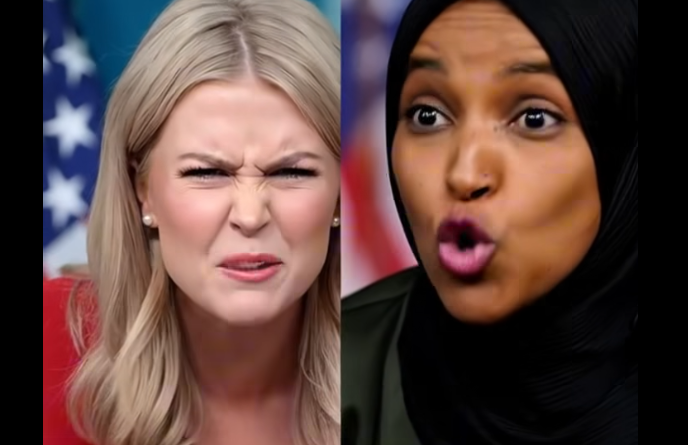
Karoline Leavitt caused a stir when she declared, “America would be safer without Somali immigrants — starting with Ilhan Omar!”
In the modern political environment, controversy often erupts not from confirmed statements, but from fragments whose origin, context, and accuracy remain uncertain. In recent days, one such fragment has dominated public discussion: an alleged quote attributed to Karoline Leavitt claiming that “America would be safer without Somali immigrants,” followed by a reference to Representative Ilhan Omar.
The words spread rapidly across social media platforms, igniting intense debate before any authoritative transcript or recording was released. What followed was not merely disagreement over policy, but a national argument about meaning, intent, and the dangers of partial information.
The speed at which the controversy unfolded illustrates how political narratives now form. A single sentence, detached from context and shared without verification, was enough to polarize audiences within hours. For some viewers, the alleged quote appeared to confirm long-standing fears about exclusionary rhetoric in American politics. For others, it seemed equally plausible that the words had been misquoted, edited, or framed to provoke outrage. The absence of a full recording or transcript did not slow the reaction; instead, it intensified speculation.
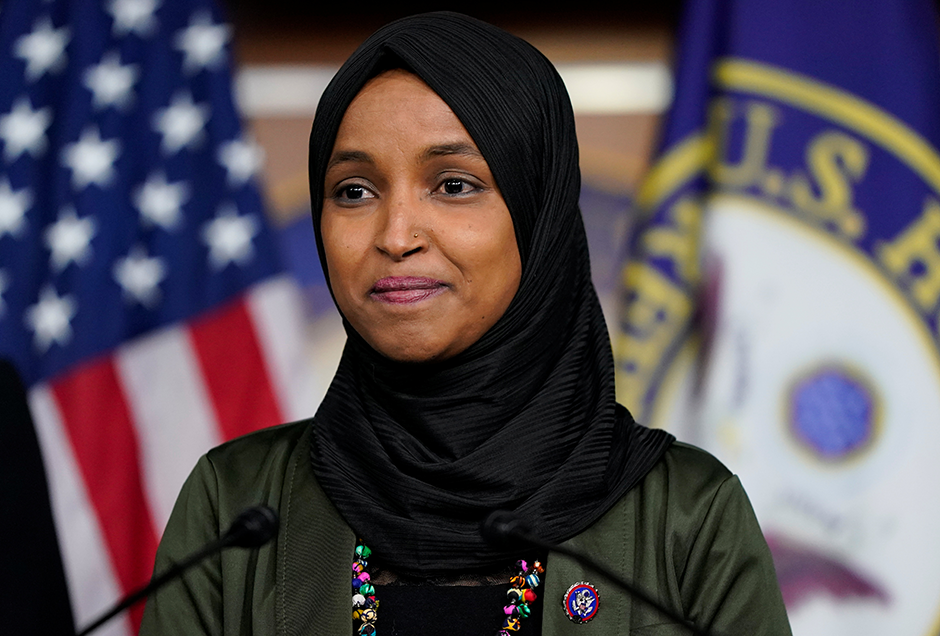
Ilhan Omar’s name, already associated with deep political division, became central to the storm. Her prominence ensured that the allegation would not remain abstract. Even without confirmation, the reference to a specific individual transformed the debate from a general discussion about immigration or national security into a personal and symbolic confrontation. In the digital arena, names function as accelerants. They sharpen attention, attract partisan engagement, and ensure that controversy travels farther and faster than policy language ever could.
Media scholars have long warned that excerpts lacking context can distort public understanding. A sentence removed from its surrounding discussion may take on a meaning never intended by the speaker, or it may exaggerate one aspect of a broader argument while suppressing others. In this case, no verified source has publicly released the full remarks in which the alleged statement was made. Without that context, audiences are left to interpret tone, intent, and scope based solely on assumptions and prior beliefs.
Supporters of Leavitt argue that the allegation reflects a deliberate misrepresentation. They claim that she was addressing national security concerns or institutional processes rather than targeting individuals or communities. From this perspective, the viral quote is seen as an example of how political opponents weaponize selective language to damage reputations. The lack of a full transcript is cited as evidence that the controversy rests on an incomplete or manipulated record.
Opponents take a different view. They argue that even if the quote were part of a larger discussion, the reported wording crosses ethical and rhetorical boundaries by appearing to single out a specific immigrant group and an elected official. For them, the controversy is not primarily about editing or context, but about the implications of language itself. In this interpretation, the naming of Ilhan Omar carries symbolic weight that cannot be dismissed as accidental or neutral.
What is striking is that both sides rely heavily on inference rather than evidence. In the absence of verified documentation, interpretation fills the gap. Social media platforms amplify this process by rewarding immediacy over accuracy. Algorithms prioritize engagement, and emotionally charged claims—whether true or false—tend to generate more interaction than cautious analysis. As a result, the most extreme interpretations often dominate visibility, while measured voices struggle to gain attention.
The role of repetition further complicates the situation. Each time the alleged quote is restated, even in the context of criticism or skepticism, it gains additional traction. Over time, repetition can blur the distinction between allegation and fact. Audiences encountering the phrase repeatedly may begin to assume its authenticity, even if every mention includes disclaimers. This phenomenon underscores the paradox of debunking in the digital age: challenging a claim can inadvertently reinforce its presence.
Political commentary programs quickly seized on the controversy, framing it as evidence of broader ideological conflict. Panels debated not only what Leavitt may have said, but what the episode revealed about immigration discourse, partisan hostility, and media responsibility. In many cases, the discussion moved further away from the original uncertainty and toward symbolic interpretations that reflected each outlet’s editorial stance. The alleged quote became a canvas onto which competing narratives were projected.
Civil society organizations and advocacy groups entered the conversation by demanding clarification. Their calls focused less on condemnation and more on transparency. Was the quote accurate? If so, what was its context? If not, how did it originate, and who was responsible for its circulation? These questions highlight a growing demand for accountability not only from politicians, but from the media ecosystem that disseminates political information.
The silence surrounding the release of a full transcript has become part of the story itself. In the absence of definitive evidence, uncertainty breeds suspicion. Some interpret the lack of clarification as avoidance, while others see it as a consequence of the allegation’s dubious origin. Either way, the delay has allowed speculation to flourish unchecked, reinforcing the idea that truth now competes on unequal footing with rumor.
This episode also reflects deeper tensions in American political discourse about identity, belonging, and representation. Immigration remains one of the most emotionally charged topics in public debate, and references to specific ethnic or national groups carry historical and moral weight. When such references appear—accurately or not—they resonate far beyond the immediate political context. The reaction to the alleged statement demonstrates how quickly discussions of policy can be overtaken by questions of values and identity.
At the same time, the controversy raises concerns about fairness and due process in the court of public opinion. Accusations based on unverified excerpts can cause reputational harm regardless of their eventual resolution. Even if a full context later disproves the claim, the initial impression may persist. This reality places immense pressure on public figures, while also challenging audiences to resist premature judgment.
If a complete and authenticated record of the remarks is eventually released, it may clarify the situation or complicate it further. Context could reveal nuance that softens the allegation, or it could confirm that the words were spoken as reported. Yet regardless of the outcome, the episode will remain instructive. It demonstrates how political narratives now form in the space between information and interpretation, where speed often outweighs certainty.
Ultimately, the controversy surrounding the alleged statement attributed to Karoline Leavitt is less about a single sentence than about the conditions that allow such sentences to dominate national conversation. It exposes vulnerabilities in how political information is shared, evaluated, and believed. Until those vulnerabilities are addressed, similar storms will continue to erupt, fueled by fragments and sustained by division.
The central question therefore remains unresolved. Where does the truth lie, and what happens when full context finally emerges? The answer will matter not only for the individuals involved, but for a public increasingly challenged to navigate a landscape where meaning is shaped as much by omission as by speech.