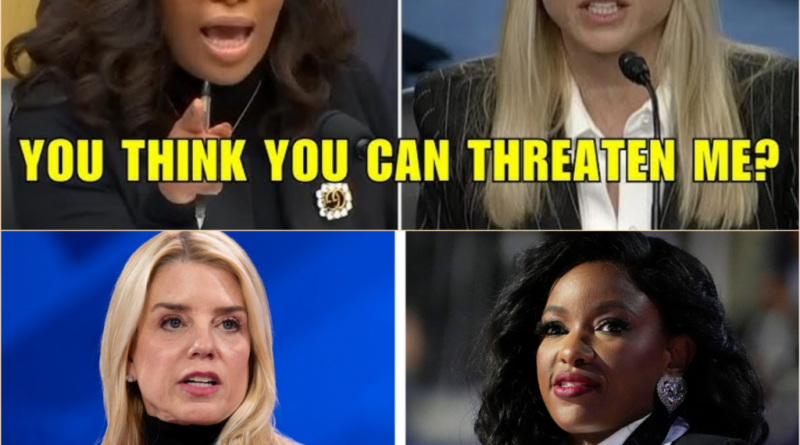
Rep. Jasmine Crockett Hits Back at AG Pam Bondi’s Retribution Threat
Rep. Jasmine Crockett Responds Forcefully to Attorney General Pam Bondi’s Threats of Retribution
In a tense and highly publicized exchange during a recent Senate investigation, Congresswoman Jasmine Crockett delivered a powerful response to Attorney General Pam Bondi’s threatening remarks. The confrontation highlighted the deep political divides and the ongoing struggle over justice, accountability, and the rule of law in the United States. Crockett’s fiery rebuke not only drew widespread attention but also underscored her unwavering stance against intimidation tactics aimed at silencing dissent within the halls of government.
Context of the Situation
The confrontation unfolded amid a broader investigation into allegations of misconduct and political retribution within the Department of Justice and related agencies. Attorney General Pam Bondi, a prominent figure in the current administration, made headlines when she publicly issued veiled threats against members of Congress who questioned her actions or voiced dissent. Her statements, often characterized as aggressive and intimidating, appeared to signal a shift toward using retribution as a tool to silence critics.
The specific circumstances that prompted Rep. Crockett’s response stemmed from Bondi’s appearance on a conservative news outlet, where she made comments suggesting that certain members of Congress, including Crockett, should be wary of crossing the line. Bondi’s tone was confrontational, and her words carried an undercurrent of warning—an implicit threat of consequences for those who dared challenge her authority or the policies she represented.
Crockett, a rising star in Democratic politics known for her eloquence and fearless advocacy, responded during a committee hearing with a fierce defense of her right to free speech and her commitment to holding power accountable. Her remarks resonated with many Americans who see the increasing politicization and weaponization of law enforcement as a threat to democracy itself.
Jasmine Crockett’s Official Response
Standing confidently before the committee, Crockett did not hold back. She directly addressed Bondi’s threats, calling out the dangers of such rhetoric in a democratic society. She stated:
“We both know that there has been a sharp incline in threats upon our lives. Regardless of what side of the aisle you sit on, we both are enduring more death threats than anybody should in this country.”
Her tone was firm, unwavering, and laced with righteous indignation. She emphasized that Bondi, as the highest law enforcement officer in the country, should be a model of integrity, not a source of intimidation. Crockett pointedly criticized Bondi’s decision to appear on a partisan platform and then issue veiled threats against her colleagues in Congress.
“It was wrong because here it is. She is the highest law enforcement agent in this country. And people are watching, and they are consuming this information, and they are believing that simply because I exercise my right to free speech, which I am entitled to do, she then wanted to politicize something that should not be politicized.”
Her words underscored the importance of protecting free speech and resisting attempts to intimidate or silence critics. Crockett’s fiery response was not merely about defending herself but about defending the broader principle that no one, regardless of rank or position, should threaten or intimidate others to serve political ends.
Analyzing the Tone and Content
Crockett’s tone throughout her response was assertive and unflinching. She used her platform to call out what she saw as dangerous overreach by the Attorney General, framing her words as a necessary stand against authoritarian tendencies. Her language was direct, emphasizing her belief that threats and intimidation undermine the very fabric of democracy.
Her critique extended beyond Bondi’s specific remarks, touching on the broader issue of political retribution and the erosion of trust in law enforcement institutions. She highlighted the importance of accountability, transparency, and the rule of law—values she believes are under threat when high-ranking officials resort to threats rather than dialogue.
Her statement also included a pointed critique of the political climate, referencing her own experiences and the climate of division that fuels violence and threats against elected officials. Her words served as a call for unity and integrity, urging her colleagues and the public to stand firm against intimidation tactics.
Public and Political Reactions
Crockett’s response quickly garnered widespread attention from both supporters and critics. Democratic allies praised her for her bravery and her unwavering stance, viewing her as a defender of free speech and a symbol of resistance against authoritarian overreach. Many saw her words as a rallying cry for accountability and the importance of standing up to intimidation, regardless of the political consequences.
Conversely, some Republicans and conservative commentators criticized her tone, accusing her of inflammatory rhetoric and suggesting that her response was overly aggressive. However, the majority of public opinion appeared to side with Crockett, emphasizing that threats against elected officials should be unequivocally condemned.
Media outlets across the political spectrum covered the exchange extensively. Progressive outlets highlighted Crockett’s courage and framed her response as a necessary stand for democracy. Conservative outlets, meanwhile, focused on her fiery language, framing it as part of a broader narrative of partisan hostility.
Implications for Future Relations
The confrontation between Crockett and Bondi has significant implications for the future of political discourse and inter-agency relations. It underscores the growing tensions within government institutions, where accusations of political bias and threats of retribution threaten to undermine trust and cooperation.
This exchange may serve as a catalyst for increased calls for accountability and transparency within law enforcement agencies. It also raises questions about the boundaries of free speech for public officials and the potential consequences of high-level threats in a democratic society.
While some analysts predict that this incident could escalate tensions between different political factions, others see it as an opportunity for dialogue and reform. Crockett’s unapologetic stance sets a precedent for elected officials to stand firm against intimidation, fostering a climate where accountability and integrity are prioritized.
Conclusion
The fiery exchange between Rep. Jasmine Crockett and Attorney General Pam Bondi marks a pivotal moment in Georgia’s political landscape. Crockett’s unwavering response to Bondi’s threats exemplifies the courage needed to challenge abuse of power and defend democratic principles. As political tensions continue to simmer, her stance serves as a reminder that standing up for justice and free speech is vital for the health of democracy. Moving forward, this incident could inspire greater accountability, transparency, and resilience among elected officials and law enforcement agencies alike.